
The Official Club Of SIET Panchkula
Welcome to the Club of Scikit-Learn Alchemists
Turning the “Lead” of Raw Data into the “Gold” of Predictive Insight.
Features & Benefits
The Complete Toolkit to Build, Launch & Scale
Scikit-learn is a popular, open-source Python library for machine learning, known for its simple and consistent API, a wide range of algorithms, and strong integration with other data science tools.
Python & ML
Here is a categorized list of powerful Python and Machine Learning terms you can sprinkle throughout your website to boost your SEO and show off your technical expertise.
Let’s Work Together
Our Activities
Elevate Your Skills with Smart, Scalable Solutions!
40+
Members
1
Activities Conducted
0
Projects Completed
Frequently Asked Questions
Got Questions? We’ve Got Answers.
What is Scikit-Learn?
Scikit-Learn is an open-source Python library used for traditional machine learning tasks like classification, regression, clustering, and dimensionality reduction.
Do I need to know Pandas and NumPy to use it?
Yes. While Scikit-Learn handles the machine learning algorithms, you will rely on Pandas to clean and manipulate your tabular data, and NumPy to structure the mathematical arrays for the model.
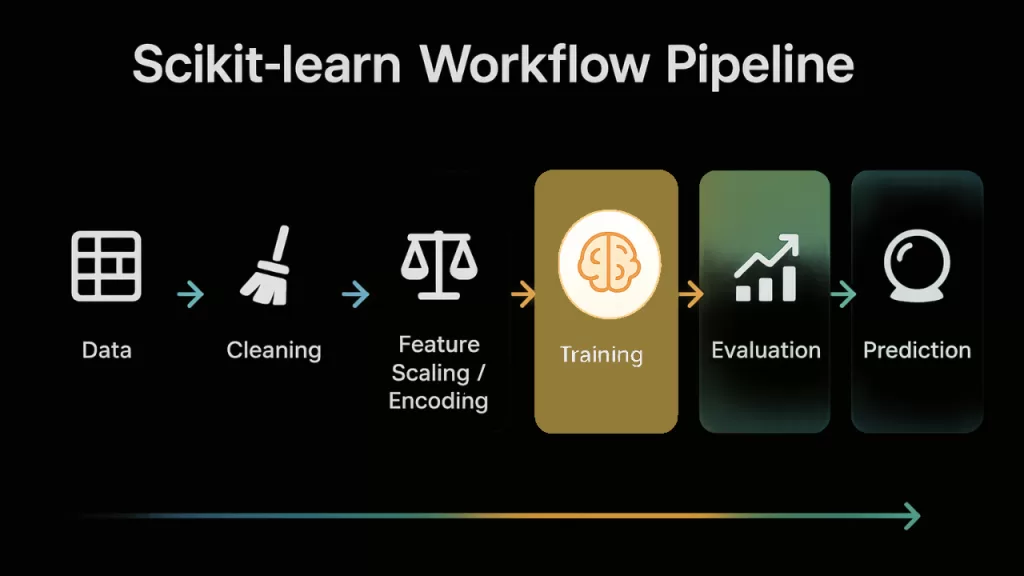
What is the standard Scikit-Learn workflow?
The typical process follows these core steps:
Make predictions and evaluate using .predict().
Preprocess the data.
Split it into training and testing sets.
Initialize an algorithm.
Train the model using .fit().
Is Scikit-Learn good for deep learning?
No. While it includes a few basic neural networks, it is optimized for traditional machine learning on tabular data. For deep learning or GPU acceleration, specialized libraries like TensorFlow or PyTorch are the standard choices.
How do I import Scikit-Learn in my code?
TEven though the library is named “Scikit-Learn,” you must use the shortened name sklearn to import it into your Python scripts. For example, you would write import sklearn or from sklearn.linear_model import LinearRegression.